Yard Management (YMS)
Every truck on your site, from the gate to the dock — booked, read at the barrier and on the record.
The gate is where a factory's day goes wrong first: drivers phoning ahead, a guard comparing plates by eye, three trucks at one dock and none at the next, and a weighing dispute nobody can settle three months later. Yard management turns that into one controlled flow. The driver registers from the phone before arriving, the visit gets a slot, the barrier rises on a confirmed plate read, the truck is assigned a dock, the scale checks the load — and every step lands in one record that nobody can quietly change.
Yard Management (YMS)
What you get
- 01
Drivers register themselves, in their own language
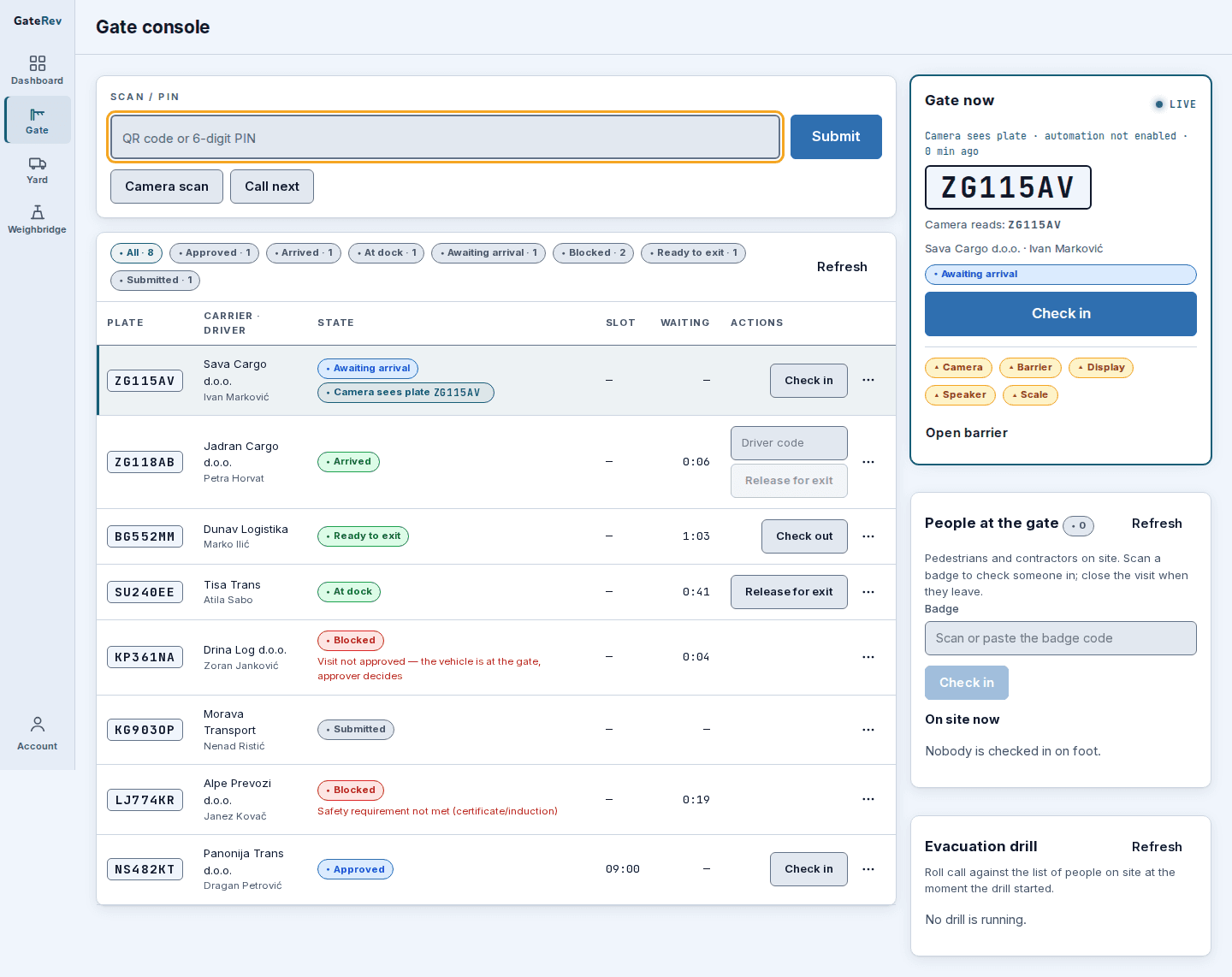
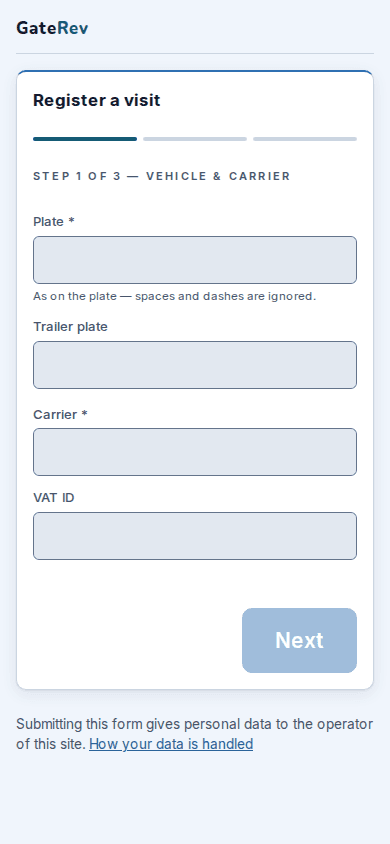
From the phone, before they reach the gate — seven languages for drivers, five for your staff. The office approves in one click, and nobody at the barrier retypes the driver's details.
- 02
The barrier rises on a confirmed plate
ANPR on your own camera confirms the plate over several consecutive reads and matches it to the approved visit. A doubtful read goes to the guard — it never goes through silently.
- 03
Time slots instead of a morning rush
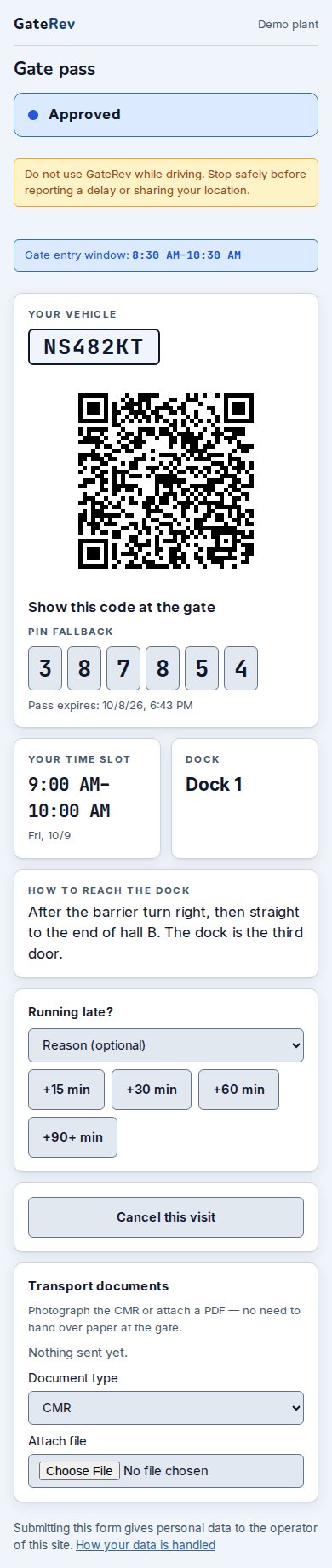
Visits are booked into slots under your rules, which every carrier accepts before its first booking. Arrival times and delays come from the carrier's TMS or straight from the driver's phone; a no-show earns a warning first, and the carrier can dispute it.
- 04
Docks, trailers and re-entry under control
Every truck is assigned a dock, trailers are tracked as objects of their own, and a returning vehicle is let back in with one click.
- 05
The scale catches what one weighing cannot show
A tare more than 20% away from that plate's own history raises an alarm, and the net is checked against the dispatch order within a 2% tolerance — at the scale, while the truck is still there.
- 06
A record that settles the argument
Every gate, dock and weighing event is written once into an append-only trail; edits and deletions are refused by the database itself. Kept for 24 months, and every removal leaves a sealed entry.
The application
What the guard, the driver and the office actually see.
Screens from the real application with made-up data; the barrier is a simulator.
Solutions
Use cases
- Turn time per visit, measured from the gate in to the gate out
- On-time arrivals, no-show rate and dock utilisation, measured from day one
- A scorecard for every carrier, built from your own data
- A live list of who is on site, and an evacuation roll-call in one click — kept for ISO 45001
- Weighing disputes settled by the record, not by memory
- An answer for the auditor who asks what happened at 06:42
How we build
Three phases. Three gates. Both conditions, or it does not advance.
Every project advances through Foundation → Integration → Autonomy. Each gate is the share of that phase's QA checklist that has to pass — and no phase advances while a single critical check is still failing, whatever the score says.
- 01
≥ 82% of checks
Foundation
MVP scaffold, core architecture, scope locked, first runnable build.
- 02
≥ 87% of checks
Integration
Feature completeness, edge cases, integrations, end-to-end tests.
- 03
≥ 88% of checks
Autonomy
Production-ready: docs, monitoring, security audit, deployment runbook.
Have a project in mind?
Tell us what you want to build. We respond within one business day.
Built by an EU-incorporated senior team — 20+ years in enterprise delivery.